

Corporate Governance
Corporate Governance
- Corporate Governance Structure
- Board of Directors
- Board Resolution
- Remuneration Committee
- Audit Committee
- Committee for Sustainable Development
- Internal Audit
- Corporate Rules & Regulations
- Risk Management policy
- Information Security Management
- Ethical Management
- ESG
- Intellectual Property Management
Chairman
& Health
Management
Service
Technology
Management
Management
Management
FAVITE Inc’s corporate governance affairs are handled by each unit by the division: the board of directors, the audit committee, and the shareholders’ meeting are handled by the accounting department; the human resources department handles the remuneration committee; the company’s operates with integrity will be coordinated and implemented by the general manager’s office.
The annual business performance is as follows:
- Arranging directors’ refresher courses.
- Plan and handle matters related to meetings such as the annual schedule of the board of directors and the date of the shareholders’ meeting.
- Prepare minutes of the board of directors and shareholder meetings.
- Assist and remind directors of the laws and regulations that should be observed when performing business or making formal resolutions of the board of directors.
- Matters concerning the release of important information on essential resolutions of the board of directors, and ensuring the legitimacy and correctness of the content of the important information, to protect the equivalence of investor transaction information.
- Regularly evaluate the performance of the board of directors in accordance with the company’s “Performance Evaluation Method for the Board of Directors”.
1. Board of Directors
FAVITE Inc. has a “Corporate Governance Principle” that requires the composition of the board of directors should consider diversity. Except for that directors who are also managers of the company should not exceed one-third of the directors, the company shouldn’t appoint independent directors in accordance with the articles of the association less than two persons, and shall not be less than one-fifth of the number of directors. Independent directors should also have professional knowledge, and should not act as directors (including independent directors) or supervisors of more than five listed OTC companies at the same time, and should maintain independence within the scope of business execution, and should not cooperate with The company has direct or indirect interests, and the company has obtained a written statement from each independent directors confirming the independence of itself and its immediate family relatives from the company. The professional qualifications of the company’s current four independent directors, restrictions on shareholding and part-time jobs, determination of independence, nomination methods, and other matters to be followed are in accordance with the Securities and Exchange Law, the establishment of independent directors of public companies and matters to be followed Measures and regulations of the stock exchange.
The current board of directors of FAVITE Inc. has a total of 9 members, including 4 independent directors. At present, the current nine directors have professional backgrounds in the industry and academia and also have expertise in business management, leadership decision-making, industrial knowledge, academics, finance and other fields. Among them, directors with employee status account for 11%, and independent directors accounted for 44%. In the future, the company will continue to add and revise the diversification policy according to the operation, operation pattern, and development needs of the board of directors, so as to ensure that the members of the board of directors should generally have the necessary knowledge, skills and accomplishments required to perform their duties. The specific management objectives and achievement of the diversity policy and independence of the board of directors are as follows:
| Management Objective | Completion Status |
|---|---|
| There shall be at least two independent directors and the number of seats shall not be less than one-fifth of the number of directors | Accomplished |
| Directors who concurrently serve as company managers should not exceed one-third of the directors' seats | Accomplished |
| Sufficient and diverse professional knowledge and skills | Accomplished |
2. Director’s Professional Background
| Title | Name |
|---|---|
| Chairman | CHEN, YUNG-HUA |
| Director | Utechzone Co., Ltd. .Representative: CHANG, WEN-CHIEH |
| Director | YEH, SHENG-FA |
| Director | Utechzone Co., Ltd. Representative: LIN, FANG-LUNG |
| Director | LIN, HUNG-JEN |
| Independent Director | TSENG, HSIANG-CHI |
| Independent Director | LEE, SHIH-CHENG |
| Independent Director | SHEN, HSI-WEN |
| Independent Director | LO, CHIH-PING |
3. Diversity Policy & Operation
1. The Company advocates and respects a policy of director diversity. To strengthen corporate governance and promote the sound development of the Board’s composition and structure, we believe a diversity approach contributes to enhancing the Company’s overall performance. The selection of board members is based on meritocracy, seeking individuals with diverse and complementary capabilities across industries. This includes fundamental qualifications and values (such as age, gender, nationality, and cultural background), as well as specific industry experience, relevant skills, professional backgrounds (e.g., legal, accounting, industry, finance, management, technology, or academia), specialized expertise, and operational experience. Additionally, candidates must demonstrate capabilities in business judgment, operational management, leadership decision-making, and crisis management. To strengthen the Board’s functions and achieve ideal corporate governance objectives, the Company’s Board shall have at least one director with an academic background, at least one director with accounting or financial expertise, and at least one director with corporate management experience as specific management targets. To achieve the goal of diverse director backgrounds, following the board election at the 2025 Annual General Meeting, the number of female directors increased from zero to two. While this has not yet reached one-third of the board seats, we will prioritize female candidates in future nomination processes and actively seek female professionals with industry experience to join. The implementation status of the board member diversity policy is as follows:
Implementation status of the board diversity policy
| Professional Title | Chairman | Director | Independent Director | ||||||
|---|---|---|---|---|---|---|---|---|---|
| Name | CHEN, YUNG-HUA | Representative of Youtian New Technology Co., Ltd.:WANG, REN-JIE | Representative of Youtian New Technology Co., Ltd.:SYU, JHIH-CHAO | LIN, HUNG-JEN | DAN, SI-JI | WANG, SHU-ZHEN | SU,XING-HUA | LEE, SHIH-CHENG | SHEN, HSI-WEN |
| Gender | Male | Male | Male | Male | Male | Female | Female | Male | Male |
| Nationality | Republic of China | Republic of China | Republic of China | Republic of China | Republic of China | Republic of China | Republic of China | Republic of China | Republic of China |
| Age | 61-70 | 41-50 | 41-50 | 61-70 | 61-70 | 61-70 | 41-50 | 51-60 | 61-70 |
| Part-time employee of the company | v | ||||||||
| Term and tenure of independent directors | Less than 3 years | Less than 3 years | 3~9 years | 3~9 years | |||||
| Expertise and Talent | |||||||||
|---|---|---|---|---|---|---|---|---|---|
| Business | v | v | v | v | v | v | v | ||
| Legal | v | ||||||||
| Technology/Innovation | v | v | v | v | v | ||||
| Finance/Accounting | v | v | |||||||
| Academic | v | ||||||||
| Capabilities and Management Experience | |||||||||
|---|---|---|---|---|---|---|---|---|---|
| Operational Judgment | v | v | v | v | v | v | v | v | v |
| Accounting and Financial Analysis | v | v | |||||||
| Business Management | v | v | v | v | v | v | v | v | |
| Crisis Management | v | v | v | v | v | v | v | v | v |
| Industry Knowledge | v | v | v | v | v | v | v | v | v |
| Global Market Perspective | v | v | v | v | v | v | v | v | v |
| Leadership | v | v | v | v | v | v | v | v | |
| Decision-Making | v | v | v | v | v | v | v | v | v |
1. The Company established a Compensation Committee upon approval by the Board of Directors on August 26, 2011. Committee members are appointed by resolution of the Board of Directors, with a minimum total membership of three. All candidates meet the qualifications stipulated by applicable laws and regulations. The Compensation Committee shall convene at least two regular meetings annually. The Compensation Committee shall exercise the following duties with the care of a prudent manager and faithfully fulfill its responsibilities, submitting its recommendations to the Board of Directors for discussion.
- Regularly review these regulations and propose amendments.
- Establish and periodically review the Company’s annual and long-term performance objectives for directors and managers, along with policies, systems, standards, and structures for compensation.
- Periodically evaluate the achievement of performance objectives by the Company’s directors and managers, and determine the content and amount of their individual compensation.
2. Term of current committee members: May 29, 2025 to May 28, 2028. The Compensation Committee convened twice during 2026, with attendance as follows:
3. Professional qualifications and experience of Compensation Committee members
Please refer to Directors’ Professional Backgrounds
4. Remuneration Committee Member
| Title | Name | Actual Attendance Count | Proxy Attendance Count | Actual Attendance Rate |
|---|---|---|---|---|
| Independent Director (Chairperson) | Wang Shuzhen | 2 | 0 | 100% |
| Independent Director | Li Shizheng | 2 | 0 | 100% |
| Independent Director | Shen Xiwen | 2 | 0 | 100% |
| Independent Director | Su Xinghua | 2 | 0 | 100% |
5. Other Matters to be Recorded:
| Date | Content | Consequent |
|---|---|---|
| 115.08.07 | 1. Proposal for Manager Promotions. | After the chairman consulted all members present, the resolution was adopted without objection. |
| 115.01.30 | 1.Establishment of the Procedures for Director Remuneration and Compensation. | With the exception of the independent directors who recused themselves from the discussion and resolution of this matter due to potential conflicts of interest, the proposal was approved as originally proposed without objection by the remaining attending independent directors. |
2.Review and Deliberation of the Company’s 2025 Managerial Year-end Bonus Plan. | After the chairman consulted all members present, the resolution was adopted without objection. |
|
| 114.08.08 | 1.Review and approve the proposal for directors’ remuneration for the year 2024 (ROC Year 113). 2.Review and approve the proposal for managerial and employee remuneration for the year 2024 (ROC Year 113). 3.Review and approve the promotion proposal for the company’s managerial personnel. 4.Review and approve the annual salary adjustment plan for the company’s managerial personnel for the year 2024 (ROC Year 113). | After the chairman consulted all members present, the resolution was adopted without objection. |
| 114.03.07 | Consideration of the amount to be provided and the method of payment of employees‘ and directors’ and supervisors' remuneration for the year 2024. | After the chairman consulted all members present, the resolution was adopted without objection. |
| 114.01.17 | Reviewed the company's 2024 manager year-end bonus plan. | After the chairman consulted all members present, the resolution was adopted without objection. |
| 113.08.09 | To review the Company’s annual salary adjustment plan for managers for the year 2024 (ROC Year 113). | After the chairman consulted all members present, the resolution was adopted without objection. |
| 113.01.26 | Reviewed the company's 2023 manager year-end bonus plan. | After the chairman consulted all members present, the resolution was adopted without objection. |
1. The Company established an Audit Committee upon approval by the Board of Directors on June 24, 2022. This Committee consists of all independent directors, with a minimum of three members. One member shall serve as convener, and at least one member must possess accounting or financial expertise.
2. This Committee assists the Board of Directors in overseeing the quality and integrity of the Company’s accounting, auditing, financial reporting, and internal control practices.
3. The Committee’s responsibilities include:
- Establishing or revising internal control systems in accordance with Article 14-1 of the Securities and Exchange Act.
- Evaluating the effectiveness of the internal control system.
- Establish or amend procedures for handling major financial and business activities, such as acquiring or disposing of assets, engaging in derivative transactions, lending funds to others, or providing endorsements or guarantees for others, in accordance with Article 36-1 of the Securities and Exchange Act.
- Matters involving the personal interests of directors.
- Significant asset or derivative transactions.
- Significant lending of funds, endorsements, or guarantees.
- Raising, issuing, or privately placing securities with equity characteristics.
- Appointment, removal, or compensation of the certifying accountant.
- Appointment or removal of the chief financial officer, chief accounting officer, or chief internal auditor.
- Annual financial reports signed or sealed by the Chairman, managers, and accounting supervisor, and second-quarter financial reports subject to auditor review and certification.
- Other significant matters as stipulated by the company or competent authorities.
4. Professional Qualifications and Experience of Audit Committee Members
Please refer to Directors’ Professional Backgrounds
5. erm of the current committee members: From May 29, 2025 to May 28, 2028.In 2026, the current audit committee held 5 meetings. Attendance details are as follows:
| Title | Name | Actual Attendance Count | Proxy Attendance Count | Actual Attendance Rate |
|---|---|---|---|---|
| Independent Director (chairman) | Wang Shuzhen | 5 | 0 | 100.00% |
| Independent Director | Li Shizheng | 5 | 0 | 100.00% |
| Independent Director | Shen Xiwen | 5 | 0 | 100.00% |
| Independent Director | Su Xinghua | 5 | 0 | 100.00% |
6. Other Matters to be Recorded:
7. Communication between Audit Committee Members and the Head of Internal Audit and the Certified Public Accountant
Audit supervisors and accountants can directly contact independent directors as needed, and the communication is good.
In addition to receiving audit reports on a monthly basis, the independent directors of the company also report on important business activities of the company to the independent directors on the board of directors and have fully communicated with the audit business implementation and results.
In the board of directors, accountants report to independent directors on the results and findings of quarterly/annual financial statements.
Summary of previous communications between independent directors, accountants ,and internal audit supervisors:
| Date | Significant communication matters with internal audit | Important communication matters with visa accountants | Recommendations and Outcome |
|---|---|---|---|
| 115/08/07 | • Internal audit engagement report | • Regulatory Change Report • Review of the Second Quarter 2026 Financial Statements, including any review issues or difficulties and management's response (separate meeting) | No objections |
| 115/05/08 | • Internal audit engagement report | • Regulatory Change Report • Review of the Third Quarter 2026 Financial Statements, including any review issues or difficulties and management's response (separate meeting) | No objections |
| 115/03/06 | • Internal audit engagement report | • Regulatory Change Report • Audit Status of Individual and Consolidated Financial Statements for the Year 2025, Including Any Review Issues or Difficulties and Management's Response (Separate Meeting) | No objections |
| 115/01/30 | • Internal audit engagement report | •N/A | No objections |
| 114/11/07 | • Internal audit engagement report | • Regulatory Change Report • Review of the Third Quarter 2025 Financial Statements, including any review issues or difficulties and management's response (separate meeting) | No objections |
| 114/08/08 | • Internal audit engagement report | • Regulatory Change Report • Review of the Second Quarter 2025 Financial Statements, including any review issues or difficulties and management's response (separate meeting) | No objections |
| 114/05/09 | • Internal audit engagement report | • Regulatory Change Report • Review of First Quarter 2025 Financial Statements, including any review issues or difficulties and management's response (separate meeting) | No objections |
| 114/04/18 | • Internal audit engagement report | •N/A | No objections |
| 114/03/07 | • Internal audit engagement report | • Regulatory Change Report • Audit Status of Individual and Consolidated Financial Statements for the Year 2024, Including Any Review Issues or Difficulties and Management's Response (Separate Meeting) | No objections |
| 114/01/17 | • Internal audit engagement report | •N/A | No objections |
| 113/11/11 | • Internal audit engagement report | • Regulatory Change Report • Review of the Third Quarter 2024 Financial Statements, including any review issues or difficulties and management's response (separate meeting) | No objections |
| 113/08/09 | • Internal audit engagement report | • Regulatory Change Report • Review of the Second Quarter 2024 Financial Statements, including any review issues or difficulties and management's response (separate meeting) | No objections |
| 113/05/03 | • Internal audit engagement report | •Regulatory change reporting •Review of financial statements for the first quarter of 2013, including any review issues or difficulties and management’s response (separate meeting) | No objections |
| 113/02/23 | • Internal audit engagement report | Regulatory Change Report •Review of individual and consolidated financial statements in 2012, including any review issues or difficulties and management’s response (separate meeting) | No objections |
| 113/01/26 | • Internal audit engagement report | •N/A | No objections |
| 112/11/03 | • Internal audit engagement report | •Regulatory change reporting •Review of financial statements for the third quarter of 2012, including any review issues or difficulties and management’s response (separate meeting) | No objections |
| 112/08/04 | • Internal audit engagement report | •Regulatory change reporting •Review of financial statements for the second quarter of 2012, including any review issues or difficulties and management’s response (separate meeting) | No objections |
| 112/05/05 | • Internal audit engagement report | •Regulatory change reporting •Review of financial statements for the first quarter of 2020, including any review issues or difficulties and management’s response (separate meeting) | No objections |
| 112/02/24 | • Internal audit engagement report | •Regulatory change reporting •Review of individual and consolidated financial statements in 2011, including any review issues or difficulties and management’s response (separate meeting) | No objections |
| 112/01/13 | • Internal audit engagement report | •N/A | No objections |
| 111/11/04 | • Internal audit engagement report | •Regulatory change reporting •Review of financial statements for the third quarter of 2011, including any review issues or difficulties and management’s response (separate meeting) | No objections |
| 111/08/05 | • Internal audit engagement report | •Regulatory change reporting •Review of financial statements for the second quarter of 2011, including any review issues or difficulties and management’s response (separate meeting) | No objections |
| 111/05/06 | • Internal audit engagement report | • The accountant explained the key points of the financial report for the first quarter of 2011. | No objections |
| 111/03/25 | • Internal audit engagement report | • The accountant explained the key points of the 110 annual financial report. | No objections |
| 111/01/21 | • Internal audit engagement report | No objections |
1. Governance Framework for Promoting Sustainable Development
To achieve Jingcai Technology’s sustainable development objectives and establish a robust governance framework, the Company established a Sustainability Committee in November 2025 in accordance with the provisions of Article 27, Paragraph 3 of the “Practical Code for Corporate Governance of Listed and OTC Companies” and Article 9, Paragraph 1 of the “Practical Code for Sustainable Development o Article 27, Paragraph 3 of the “Corporate Governance Best Practices for Listed and OTC Companies” and Article 9, Paragraph 1 of the “Sustainable Development Best Practices for Listed and OTC Companies,” the Company established a Sustainable Development Committee (hereinafter referred to as “the Committee”) in November 2025 and formulated organizational regulations to implement sustainable governance mechanisms and strengthen the Board of Directors’ oversight responsibilities regarding environmental, social, and governance (ESG) issues.
2. The Company’s Board of Directors approved the establishment of the Sustainability Committee on November 7, 2025. The Committee shall consist of no fewer than three members appointed by the Board of Directors, with at least one director participating in its oversight.
3. Responsibilities of the Sustainability Committee:
- Review and approve the Company’s sustainability policies, strategies, and objectives.
- Monitor the progress and effectiveness of the Company’s sustainability initiatives.
- Periodically review the content of sustainability plans and reports.
- Evaluate significant sustainability issues and stakeholder engagement outcomes.
- Report on implementation progress to the Board of Directors at least once annually.
4. Operations of the Sustainability Committee
| Related tasks | Key Initiatives |
|---|---|
| Environmental Sustainability Group | Developing Operational Strategies in Response to Climate Change |
| Product Sustainability Design Group | Drive Product Innovation and Service Enhancement |
| Corporate Social Responsibility Group | Ensure employees have a safe and healthy work environment |
| Corporate Governance Group | Establish a corporate governance framework and ethical conduct standards |
Term of Office for Current Committee Members: November 7, 2025 to May 28, 2028.
The Sustainable Development Committee held 2 meetings in 2026, with attendance as follows:
| Title | Name | Professional Qualifications and Experience | Actual Attendance | Proxy Attendance | Actual Attendance Rate |
|---|---|---|---|---|---|
| Chairman (Director) | CHEN, YUNG-HUA | Specializes in product R&D and operational management, with expertise in energy conservation, carbon reduction, and energy management system implementation. | 2 | 0 | 100% |
| Committee Member | WANG, ZI-YUE | Possesses operational management experience in the optoelectronics and semiconductor equipment industries, with expertise in corporate governance, risk management, and sustainable industry development trends. | 2 | 0 | 100% |
| Committee Member | TSENG, TSAI-WEI | Possesses professional background in financial accounting and corporate sustainability reporting. | 2 | 0 | 100% |
5. Other Matters to be Recorded
| Date | Motion Content | Resolution Result | Date of submission to the Board |
|---|---|---|---|
| 2026/7/27 | I. Reports Items: (1) Results of 2025 Greenhouse Gas Inventory Verification (2) Progress Report on the Implementation Schedule for 2026 Second-Quarter Greenhouse Gas Inventory and Verification II. Discussion Items: Proposal 1: 2025Sustainability Report. Proposal 2: Proposed amendments to certain provisions of the “Operational Procedures for the Preparation and Assurance of the Sustainability Report.” | The above matters have been reviewed, discussed, or approved by the committee. | 2026/8/7 |
| 2026/1/19 | I. Reports Items: (1) 2025 Sustainability Development Execution Results and 2026 Target Plan II. Discussion Items: Proposal 1: 2026 Materiality Topics Proposal 2: 2026 Sustainability Strategy Roadmap | The above matters have been reviewed, discussed, or approved by the committee. | 2026/1/30 |
| 2025/12/30 | I. Report Items: (1) 2025 Greenhouse Gas Inventory and Verification Plan Report (2) 2025 Sustainability Report Preparation Schedule Plan | The above matters have been reviewed, discussed, or approved by the committee. | 2026/1/30 |
Internal Audit
FAVITE Inc’s internal audit is an independent unit, directly subordinate to the board of directors, and has a full-time auditor. In addition to reporting at the regular meeting of the board of directors, it reports to the chairman every month or when necessary. The internal audit regulations stipulate that internal auditors review the company’s internal control procedures and report on the adequacy, effectiveness, and efficiency of the design of such controls and routine operations, covering all operations of the company and its subsidiaries.The audit method is mainly carried out by the annual audit plan approved by the board of directors, and also conducts special audits or reviews according to actual needs, so as to timely discover possible deficiencies in internal control and provide suggestions for improvement. To sum up the above, the execution of general audits and projects can provide management with knowledge of the operation status of internal control, and it is another channel for management to understand existing or potential deficiencies.
In addition, the internal audit also urges each unit to perform self-assessment, establish a company self-monitoring mechanism, and use the assessment results as a basis for recommending the company’s board of directors and general manager to issue an internal control statement.
Risk Management policy
FAVITE Inc. has a “Risk Management Policy” which will be approved by the board of directors in 2022. Risks are assessed regularly every year, and various risks are defined in accordance with the company’s overall operating policy. Within the acceptable risk range, possible losses are prevented to increase shareholder value. And achieve the optimization principle of the company’s resource allocation.Risk Management Scope
Risk Type1. Strategy Risk
The impact on the Company’s financial business due to changes in the overall domestic and foreign economic situation, and important policies and laws.2. Operational Risk
Including risks of sales concentration, procurement concentration, legal regulations, talent recruitment and retaining, and impacts of technological and industrial changes, etc.3. Financial Risk
Interest rate changes, exchange rate changes, inflation, deflation, as well as impacts on the Company’s profits and losses due to policies for high-risk/high-leverage investment, capital loans to other parties, endorsements, and derivative commodity transactions.4. Information Risk
The risks of information disclosure of the Company’s major operating information, personal data, and/or client data required to be protected under contract provisions due to computer viruses, hacking, and/or various internal and external information security threats.5. Legal Risk
Failure to comply with relevant regulations or the contract itself has no legal effect, ultra vires behavior, poor regulation, omissions in clauses or other factors, resulting in the inability to constrain the transaction partner to perform its obligations in accordance with the contract, which may result in the risk of financial or reputation losses.6. Integrity Risk
Risks caused by wrong behavior or improper handling of personnel, or violations of corporate ethics and business ethics (such as: corruption, gift acceptance, bribery, leaking secrets, conflicts of interest, etc.)7. Other Risk
Such as sudden natural disasters or climate change; water and electricity supply; impact of epidemic infectious diseases and other emerging risks.Organization Structure
1. Board of Directors
FAVITE Inc.’s board of directors is the highest unit of the company’s risk management. It aims to follow laws and regulations, promote and implement the company’s overall risk management, clearly understand the risks faced by operations, ensure the effectiveness of risk management, and bear the ultimate responsibility for risk management.2. Senior Management
The general manager is the command center, and is responsible for business decision-making planning, implementing the risk management decisions of the board of directors, and coordinating cross-department risk management interaction and communication to reduce strategic risks.3. Audit Unit
The audit office is affiliated with the board of directors, assisting the board of directors and managers to inspect and review the deficiencies of the internal control system, and measure the effectiveness and efficiency of operations. An annual audit plan is drawn up based on the risk assessment results every year, and the audit implementation results are regularly reported to the Audit Committee and the Board of Directors.4. Authority
Each authority and responsibility unit is the direct unit for initial risk discovery, assessment, and control. The supervisor of the business execution unit is responsible for risk management and is responsible for supervising and controlling the relevant risks within the unit to ensure that the company’s risk management system can completely and effectively control the relevant risks.Operating Condition
Since 2022, FAVITE Inc. has actively promoted the implementation of the risk management mechanism. Through the operation and management meeting chaired by the general manager or the relevant operation supervisor, the company is responsible for the risk assessment of various operation plans and projects, and the personnel of each dedicated department identifies potential risks within the scope of their duties. risk, evaluate, and formulate response control plans and returns, and report to the board of directors on November 7, 2025 on the operation of risk management. Operational status of relevant risk management such as risk assessment and response measures.Risk Management Policy and Procedure(Download)
Information Security Management
In order to maintain the confidentiality, integrity and availability of the company’s information assets, comply with the requirements of relevant laws and regulations, and protect user data privacy from internal and external deliberate or accidental threats. The company integrates the information security objectives of departments at all levels and establishes the company’s overall information security policy objectives as follows:Information Security Committee
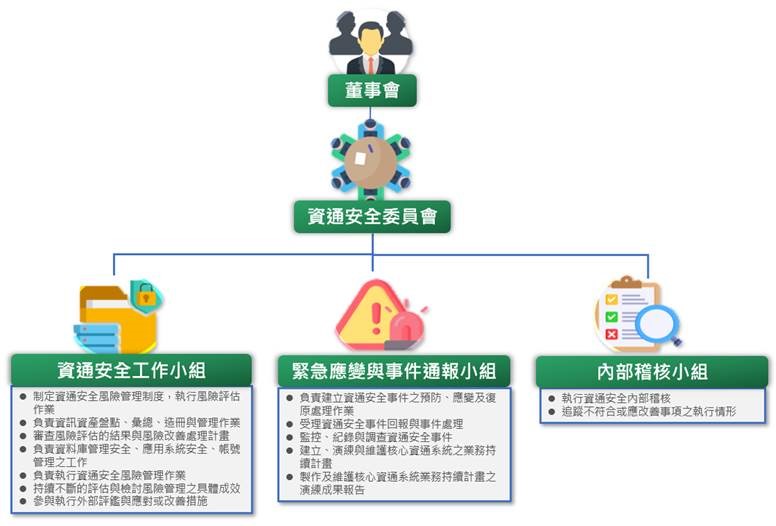
Information Security Management Measures
The Company obtained ISO 27001 Information Security Management System certification in December 2023 and successfully completed its recertification in November 2024, demonstrating that the design and operation of its information security management system meet international standards. All employees are required to adhere to relevant information security regulations. The company employs annual reviews and internal audit mechanisms to continually verify whether management measures align with operational environment changes and technological advancements. Revisions are implemented as necessary to maintain the system's effectiveness and appropriateness. Furthermore, the company continually strengthens its technical defence capabilities by implementing multi-layered security protection mechanisms (such as network perimeter protection, intrusion detection and prevention, malware protection, email and web filtering, etc.), comprehensively enhancing the overall security of the information environment. The expenditure on information security-related initiatives over the past three years is as follows, reflecting the company's emphasis on and sustained investment in information security management.| Year | Cybersecurity Investment Costs (TWD) |
|---|---|
| 2023 | 1,200,000 |
| 2024 | 1,400,000 |
| 2025 | 3,060,000 |
Key information security management measures are outlined below:
Invest resources in information security management
Information security education and training
To foster an information security culture where every employee feels engaged, the company annually organises multi-tiered information security training and awareness campaigns. These systematically enhance both the technical expertise and protective awareness of all personnel, from dedicated information security officers to the entire workforce.- Specialist Training for Designated Officers:
Annual advanced training for dedicated information security personnel is conducted to strengthen their professional knowledge and practical capabilities. In 2025, a total of 36 hours of professional training was completed for 6 personnel. Content covered the latest information security threat trends, updates to domestic and international information security and personal data protection regulations, information security management frameworks, and technical control measures. This ensures professional personnel can effectively support the company's overall information security governance requirements. - Company-wide Information Security Awareness and Education:
To continuously heighten all employees' vigilance against social engineering, phishing emails, data breaches, and device usage risks, the company conducts regular annual information security awareness campaigns. These utilise presentations, case studies, and quizzes to deepen staff understanding of security risks and promote correct protective behaviours. Beyond awareness campaigns, the company also delivers formal information security training courses. These reinforce correct concepts and operational standards regarding password management, access rights usage, controls for taking confidential documents and devices off-site, and the use of cloud services and mobile devices. In 2025, the company completed information security training for all employees, totalling 163 participants and 489 hours. This effectively enhanced staff understanding and implementation of information security policies and practical control requirements.
Through the aforementioned institutionalised information security management mechanisms and continuous talent development initiatives, the Company has steadily enhanced its overall protective capabilities within a rapidly evolving and increasingly challenging cybersecurity landscape. This approach mitigates information security risks while safeguarding operational stability and protecting stakeholder interests.
Ethical Management
FAVITE Inc. has established the “Principle of Integrity Management”, which regulates internal management and external business activities. It should be based on the concepts of integrity, transparency and responsibility, and abide by laws and regulations.Executive Division
FAVITE Inc.’s general manager office supervises the relevant operations in accordance with the work duties and scope of each unit to ensure the implementation of the principle of integrity management.Executive condition
1. Formulate integrity management policies and plans| No. | Executive Project | Operating Condition |
|---|---|---|
| (1) | Does the company clearly state the policies and practices of integrity management in its regulations and external documents, as well as the commitment of the board of directors and management to actively implement the business policies? | FAVITE Inc. has a “Principle of Integrity Management”, which is actually implemented in internal management and external business activities; in addition, the company’s “Board of Directors’ Rules of Procedure” also specifies the director’s interest avoidance system. Those who represent the interests of a legal person shall explain the important content of their interests at the meeting of the board of directors. If there is a risk of harming the interests of the company, they shall not participate in the discussion and vote, and shall avoid the discussion and vote, and shall not act as an agent for other parties. Directors exercise their voting rights. |
| (2) | Does the company formulate a plan to prevent dishonesty, and clearly stipulate operating procedures, behavior guidelines, punishment and complaint systems for violations in each plan, and implement them? | FAVITE Inc. has a “Principle of Professional Ethics for Employees”, which states that employees must not use their powers to seek illegal benefits, accept entertainment, gifts, kickbacks, embezzle public funds or other illegal benefits, so as to prevent dishonest behavior from affecting business relationships or transactions. |
| (3) | Does the company take preventive measures against the subparagraphs of Item 2 of Article 7 of the “Principle of Integrity Management for Listed OTC Companies” or other business activities within the scope of business that have a relatively high risk of disintegrity? | FAVITE Inc. has established relevant preventive measures for the risks arising from relatively high levels of Integrity. |
2. Implement Integrity Management
| No. | Executive Project | Operating Condition | ||||||||||||||||||||||||
|---|---|---|---|---|---|---|---|---|---|---|---|---|---|---|---|---|---|---|---|---|---|---|---|---|---|---|
| (1) | Does the company evaluate the integrity records of its counterparties, and specify the terms of honest behavior in the contracts it signs with its counterparties? | FAVITE Inc. abides by the Company Law, Securities Exchange Law, Commercial Accounting Law, relevant regulations on listing and OTC listing, or other business conduct-related laws and regulations as the basis for implementing honest management. |
||||||||||||||||||||||||
| (2) | Does the company set up a unit affiliated to the board of directors to promote corporate integrity management, and regularly report its implementation to the board of directors? | The General Manager's Office oversees relevant matters based on the responsibilities and scopes of each department to ensure the implementation of the Code of Integrity. It reports to the Board of Directors at least once annually on the plans and progress of promoting integrity management. The General Manager reported on the implementation status of these operations to the Board of Directors on November 7, 2025. |
||||||||||||||||||||||||
| (3) | Does the company formulate policies to prevent conflicts of interest, provide appropriate reporting channels, and implement them? | Employees’ opinions can be reflected to the management through multiple channels. Regularly train and communicate with employees to protect the rights and interests of employees while preventing unintegrity behavior. |
||||||||||||||||||||||||
| (4) | Has the company established an effective accounting system and internal control system in order to implement honest management, and has it been regularly checked by the internal audit unit, or has an accountant been entrusted to perform the check? | FAVITE Inc. has established the “Principle of Integrity Management” and “Standards of Professional Ethics for Employees” as the basis for implementing integrity management. And in order to ensure the implementation of honest management, the company has established an effective accounting system and internal control system, and internal auditors regularly check the compliance with the preceding system. |
||||||||||||||||||||||||
| (5) | Has the company formulated measures to prohibit insider trading and implemented them? | The Company has established the “Internal Procedures for Handling Material Information and Preventing Insider Trading” to ensure consistency and accuracy in information disclosed to the public and to strengthen safeguards against insider trading.
The Company has established a “Code of Corporate Governance Practices” and conducts annual awareness campaigns regarding the prohibition of insider trading, reminding directors and insiders that they must not trade in the Company’s shares during the blackout periods of 30 days prior to the announcement of the annual financial report and 15 days prior to the announcement of the quarterly financial report.
|
3. The operation of the company whistleblowing system
| No. | Executive Project | Operating Condition |
|---|---|---|
| (1) | Does the company formulate a specific whistleblowing and reward system, establish channels to facilitate whistleblowing, and assign appropriate specialists to handle whistleblowers? | FAVITE Inc. has established the “Principle of Integrity Management” and “Principle of Professional Ethics for Employees”, which can be reported to the management through multiple channels, and the company will implement punishment according to the regulations. By establishing good corporate governance, risk control mechanism and perfect internal regulations, we can prevent the occurrence of dishonest behaviors and create an operating environment for the company’s sustainable development. |
| (2) | Does the company formulate investigation standard operating procedures and related confidentiality mechanisms for accepting reports? | The company has established the “Principle of Integrity Management” and “Principle of Professional Ethics for Employees”, which specify the company’s investigation standard operating procedures and related confidentiality mechanisms for accepting reports. |
| (3) | Does the company take measures to protect whistleblowers from being improperly dealt with due to whistleblowing? | FAVITE Inc. has established the “Principle of Integrity Management” and “Principle of Professional Ethics for Employees”, which specify the company’s measures to protect whistleblowers from being mistreated due to whistleblowing. |
Board Member Succession Planning and Operating
FAVITE Inc.’s “M&A” stipulates that the election of directors adopts a comprehensive candidate nomination system, and it is stipulated in the “Corporate Governance Practice Code” and “Director Election Procedures” that the composition of the board of directors should consider diversity, and consider the company’s own operations, business model and Develop diversified policies for development needs, including but not limited to the standards of basic conditions and values or professional knowledge and skills.The company establishes a database of director candidates according to the following standards:
Key Management Succession Planning and Operating
The main structure of the company’s key management succession planning is as follows:1. According to the future development strategy, define the company’s required positions and talent needs, and regularly review the succession plan in response to changes in operations and strategies.
2. Discover potential and talented executives to enter the succession planning candidate talent pool, and establish a sound training mechanism and talent development plan for training.
3. Promptly promote middle-level supervisors as job agents of senior supervisors, and understand the cultivation status of middle-level supervisors through performance appraisal and use it as a reference for succession planning.
Intellectual Property Management
The purpose of the company is to produce high-quality, high-precision automatic testing equipment, and continue to research and develop to enhance the company’s value and competitiveness. In order to maintain this purpose, protect R&D results and respect the intellectual property of others, the following intellectual property management plan is specially established to strengthen corporate governance and ensure sustainable operation.1. Patent Management
- Protect R&D results by applying for and obtaining patents.
- The proposal to apply for a patent for the research and development results, and to apply for and obtain a patent for the research and development results with the competent authorities of domestic and foreign intellectual property rights shall be handled and handled by the responsible units within the company.
- After the research and development results are granted a patent by the competent authority of intellectual property rights, the preservation of the relevant application and approval documents of the patent, as well as the maintenance of the patent, are handled and handled by the company’s legal office.
- Regularly review the application of the patented research and development results to assess the need for continued maintenance.
- The “Research and Creation and its Incentive Measures” have been formulated to encourage and reward the company’s employees to engage in job-related research and development, creation and improvement.
- In the employment contract between the company and its employees, it has been aimed at the employee’s job completion, not based on the job’s needs but related to the job, and not related to the job but completed using the company or the company’s affiliated companies For inventions, new models or designs based on resources or experience, the ownership of patent application rights and patent rights shall be expressly stipulated.
2. Trademark Management
- FAVITE Inc.’s trademark has been approved and registered by the authority since 2004, and after years of layout, it has gradually become complete, covering relevant categories, and has spread throughout major countries.
- Regularly registered and announced trademarks and review their use conditions to assess the necessity of continuing to extend the period of trademark rights.
- According to the company’s future business development, weigh the application for registration of a new trademark.
- Matters related to the application for registration of new trademarks, as well as the extension of the period of trademark rights of trademarks that have been registered and announced, are handled and handled by FAVITE Inc.’s legal office。
3. Copyright Management
- FAVITE Inc. has set up a software research and development unit to develop the application software required for the assembly and matching of various products by itself, so as to effectively reduce the problem of adaptability
- In the employment contract between the company and the employee, the works completed by the employee on the job, the works not based on the needs of the job but related to the job, and the works not related to the job but completed using the company or this company For works on the resources or experience of corporate affiliates, expressly agree on the author, the ownership of the copyright, and the ownership of the original copy of the work.
4. Management of Trade Secrets
- The employees of the company must take corresponding confidentiality measures for sales, research and development, procurement, manufacturing, and operation information, materials and documents that they receive or receive, which have economic value or are confidential.
- The company’s computer equipment can only be used by employees who log in and identify with a password, and the password must be changed regularly, and the rights to read and access computer files are controlled according to the nature of the employee’s job.
- The company will allocate personal access control magnetic cards to employees, and control their access rights according to the nature of the employee’s duties. When visitors enter the company, their identity will be registered, and a temporary identity badge will be provided for them to wear, and they will be accompanied by the company’s employees throughout the process.
- Regularly remind and publicize employees not to disclose business secrets.
- When the employees of the company leave the company, they must hand over the information, materials and documents under their control.
- In the employment contract between the company and the employees, it has been clearly stipulated that the employees shall not disclose, provide or present the information, materials and documents of the company that they have learned that have economic value or confidential nature during the period of employment and within a certain period of time after resignation to others.
- If the company needs to disclose or provide its economic value or confidential information, materials, or documents to a business partner, it must sign a confidentiality contract or clause with the target to protect the above information, materials and documents.
5. Management of Infringement
- In the employment contract between the company and its employees, as well as in the “Intellectual Property Management Measures” stipulated by the company, there are express restrictions on employees:
- No direct, indirect or disguised use or use of software, business secrets or other intellectual property that is not legally authorized in the location, region and scope of the company’s business, and no infringement of other people’s software, business secrets or other intellectual property Behavior.
- Do not directly, indirectly or in disguise use or utilize the software, business secrets or other wisdom of others received, contacted or known in the work or position before employment in the company in the location, region and scope of the company’s business property.
- All works done on the job, or not based on the needs of the job but related to the job, are all created by themselves, and there is no plagiarism, imitation, or infringement of other people’s copyrights, patents, trade secrets, and intellectual property rights in any way. .
- When the company has a dispute over software, business secrets, or other intellectual property, the company’s legal office may, at its discretion, or appoint or entrust external professionals to deal with it.
6. Executive Condition
- FAVITE Inc. reports to the board of directors at least once a year on the intellectual property management plan or its major implementation. The latest report date is November 11, 2025.
- The company’s intellectual property list and achievements as of September 30, 2025, are as follows:
- There are 3 valid invention patents, 2 valid model patents, and 8 valid trademarks.
- There are “Intellectual Property Management Measures” and “R&D Creation and Its Incentive Measures” formulated.
- There are no cases of litigation over software, trade secrets, or other intellectual property.